
From Steel to Success: How Slovakia Became the World’s Car Manufacturing Champion
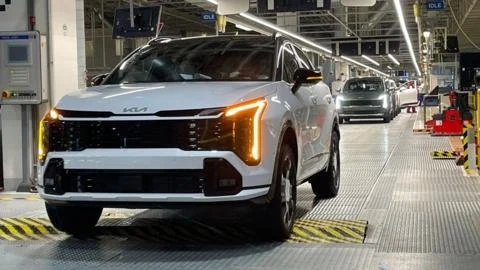
In a breathtaking landscape surrounded by snow-capped mountains, the factory floors of Slovakia are buzzing with activity, where Kia leads the charge as one of the world’s leading car manufacturers. Situated near Zilina, this €2.5 billion facility boasts an impressive assembly line that churns out a car every minute, with a fleet of 690 robots and dedicated human workers turning metal into vehicles that have put Slovakia on the automotive map.
Slovakia, with a population of just 5.4 million, produces nearly 1 million cars a year, ranking it as the number one country in terms of car production per capita, even surpassing giants like China. The assembly line showcases employees like Marcel Pukhon and Simona Krnova, who express pride in their roles despite varying levels of passion for the work. With wages at the Kia plant averaging €2,400 per month, they enjoy significantly higher salaries compared to Lithuania’s average, though still below the EU average.
Historically, the Slovak car industry underwent a massive transformation post-Velvet Revolution in 1989, attracting foreign investments like Volkswagen’s acquisition of Skoda. The country now boasts multiple multinational manufacturers including Volkswagen, Stellantis, and Jaguar Land Rover, and is set to welcome a Volvo electric car factory by 2027.
Cost advantages and productivity are critical to Slovakia’s success. Labour costs are around 60% of Western European levels, thus luring manufacturers seeking efficiency and profitability. With its central position in Europe, Slovakia effectively serves major markets, particularly the UK, where Kia has become the fourth best-selling brand. Notably, the country generates electricity predominantly from low-carbon sources, enhancing its attractiveness for electric vehicle production.
Moreover, an expansive network of 360 suppliers supports the automotive sector, solidifying its status as a European hub. The Slovakian government incentivizes industries to grow, leading to a decline in unemployment and economic strength in regions like Zilina. Educational programs bridge the gap between theory and practice, producing skilled graduates for the automotive industry.
As more countries in Central and Eastern Europe rise as manufacturing centers, thanks to the capital influx and a skilled workforce, Slovakia stands at the forefront, proving that with the right conditions and investments, a small nation can dominate the global stage in car production.