
Is Greenland the New Battlefield? Europe Stands Firm Against Trump's Tactics
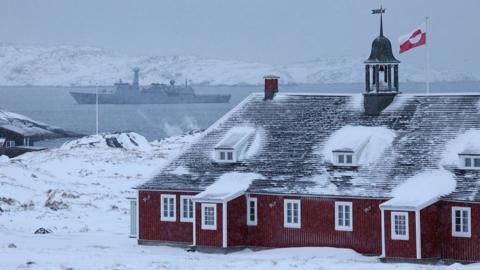
Denmark’s Prime Minister Mette Frederiksen has firmly declared that Europe won’t be blackmailed by President Donald Trump’s recent threats regarding Greenland. In an escalating conflict, Trump announced plans to impose a 10% tariff on goods from eight allied nations unless they support his controversial bid to acquire Greenland. During a statement, Frederiksen joined other European leaders to express their concerns that the tariffs could undermine transatlantic relations and lead to a dangerous downward spiral.
Trump’s insistence that Greenland is critical for U.S. national security has drawn significant backlash, especially since he has claimed that the acquisition could happen ”the easy way” or “the hard way.” He has implied potential use of force, prompting widespread criticism from leaders around the globe. The proposed tariffs would initially apply on February 1 and could escalate to 25% by June, potentially affecting Denmark, Finland, France, Germany, the Netherlands, Norway, Sweden, and the UK.
In response to Trump’s threats, Frederiksen publicly emphasized that Europe favors cooperation rather than conflict, stating that the continent stands united against coercion. UK Prime Minister Sir Keir Starmer also condemned the tariff threats as ”completely wrong”, affirming the UK’s intention to address the matter directly with the White House.
The geopolitical implications of the Greenland situation are significant. Greenland, resource-rich and strategically located, poses a valuable asset for military defenses, particularly regarding missile attacks and surveillance in the Arctic region. Remarks from U.S. Treasury Secretary Scott Bessent highlighted that retaining Greenland under U.S. control is vital for its defense.
European leaders, including Emmanuel Macron, are coordinating their response, with Macron suggesting mobilizing the EU’s anti-coercion instrument should the tariffs be enacted. Public sentiments in Denmark and Greenland reflect widespread opposition to Trump’s threats, with demonstrations taking place in Nuuk and Danish cities. A poll indicating that 85% of Greenlanders oppose becoming part of the U.S. highlights the democratic resistance against Trump’s ambitions.
The ongoing dialogue during forums like the World Economic Forum in Davos will further address the tensions surrounding Greenland and the Arctic, emphasizing the need for collaborative security efforts among NATO members.