
Unlocking the Quantum Frontier: Inside the World's Most Powerful Computer
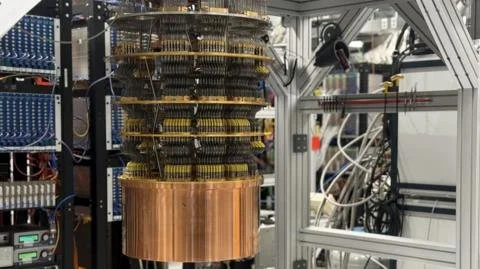
In the heart of Santa Barbara, California, at a Google facility, lies Willow, a quantum computer that represents a groundbreaking leap in technology—intriguingly encased in what resembles a golden chandelier, it houses the coldest place in the known universe. This cutting-edge machine is not just any ordinary computer; it plays a crucial role in securing financial stability, decrypting government secrets, and shaping the global economy.
Hartmut Neven, the head of Google’s Quantum AI, describes Willow as a quantum marvel that can outperform classical computers dramatically. He reveals that Willow has proven, once and for all, that quantum computers can tackle tasks that are impossible for traditional systems, solving benchmarks in mere minutes that would take classical computers 10 septillion years to compute.
The Willow quantum chip boasts 105 qubits, a stark contrast to Microsoft’s 8 qubits, utilizing superconducting qubit technology. Neven highlights the potential applications of Willow, from enhancing medical discoveries to improving food and energy efficiency, all while tackling climate change and human hunger. Some researchers suggest that true Artificial Intelligence might only be achievable through quantum computing.
However, this transformative technology must navigate the challenge of error correction to improve its reliability, demonstrating a significant leap towards executing up to a trillion operations in the near future. As Neven explains the theoretical capabilities of quantum computers, he draws an analogy to sorting through thousands of drawers: where classical computers sequentially open each drawer, quantum computers can operate on them all simultaneously.
Meanwhile, the global race for quantum supremacy is heating up, with concern over national security and economic advantages. In China, for example, massive investments focus on developing fast quantum technologies, led by pioneering physicist Pan Jianwei, including their Zuchongzhi 3.0 quantum computer that competes with Willow’s capabilities. The stakes are immense, potentially allowing for the decryption of everything from state secrets to cryptocurrencies, raising alarms within the tech community regarding the future of digital security.
The UK is positioning itself as a significant player in quantum research, planning significant investments to boost its standing in this critical technological field. As these developments unfold, giant leaps in understanding the universe and our reality emerge, with even some speculating on the multiverse theory as a potential explanation for the unparalleled computing power of quantum systems. All of this sounds like science fiction, yet it is quickly becoming a concrete reality, setting the stage for a quantum era in the next 25 years.