
India and the EU Forge a Game-Changing Trade Alliance Amid Global Tensions
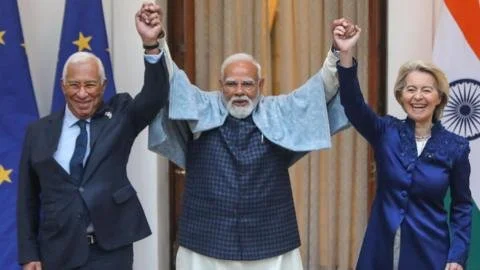
The European Union and India have made headlines by finalizing a groundbreaking trade deal after nearly two decades of negotiations, driven by a shared goal to enhance their trade and strategic relationship amidst increasing pressure from the United States. European Commission President Ursula von der Leyen announced the achievement while attending a bilateral summit in Delhi with Indian Prime Minister Narendra Modi and European Council President António Costa. The deal, hailed as the “mother of all deals,” is framed as a free trade zone for two billion people, aiming to benefit both sides.
In the context of rising protectionism, particularly from the U.S., the deal signals a stronger belief in trade agreements over tariffs. Modi emphasized the deal’s significance, highlighting that it accounts for 25% of the global GDP and a third of global trade. Market access will expand for Indian products in Europe while allowing European goods, including cars and beverages, to penetrate Asia’s third-largest economy more easily.
This trade agreement, resulting from years of stalled discussions since their inception in 2007, was rekindled in July 2022. Key obstacles included issues surrounding automobile access, agricultural goods, and carbon-linked tariffs. A formal signing of the deal is anticipated later this year, pending approval from the European Parliament and the European Council. The EU stands as India’s largest trading partner, and this partnership is further solidified as both parties seek new alternatives in response to geopolitical challenges. With recent trade accords with the UK, Oman, and New Zealand, along with an existing agreement with the European Free Trade Association, India aims to bolster its global trading network.