
Sailing into the Future: How 3D Printing is Revolutionizing Boat Building
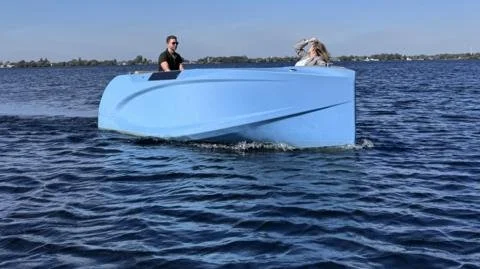
In a groundbreaking development for 3D printing technology, Maarten Logtenberg and his team at CEAD have successfully created 3D printed boats that promise to change the landscape of maritime manufacturing. After two years of meticulous experimentation, they discovered a unique blend of thermoplastics and fiberglass that not only boasts remarkable strength but is also resistant to environmental threats such as solar exposure and marine growth. This material is essential for the production of resilient boat hulls, traditionally a labor-intensive and time-consuming process.
The process at CEAD has been transformed, as they now automate nearly 90% of boat-building, drastically shortening production time from weeks to just a few days per hull. Logtenberg emphasizes this efficiency, stating, “We print one now every week,” reflecting the potential for significant cost reduction and labor savings in boat manufacturing. By shifting the focus from merely building 3D printing machines to actually using them for production, CEAD is taking direct action in the market adoption of 3D-printed vessels.
The manufacturing approach employed by CEAD is in stark contrast to the traditional boat-building method, which relies heavily on manual labor and molds. Instead, their additive manufacturing method constructs boats in layers according to a digital design, requiring minimal human intervention once the setup is complete. This level of automation allows for quick adjustments in design without significant reworks in the production line, making the process highly flexible and efficient.
One of CEAD’s notable projects includes the rapid creation of a 12-meter prototype for the Dutch Navy, which was produced in just six weeks at a fraction of the usual cost. This speedy delivery could vastly benefit industries like defense, where timely availability is crucial. Additionally, their technology is being applied to the emerging field of autonomous vessels, showing the versatility of 3D printing in meeting modern operational needs.
Just down the road, Raw Idea is working on a similar technological leap in the leisure boating sector, creating 3D printed rental boats that leverage recycled materials to offer competitive pricing. Marketing the novelty of 3D printing in their boats has generated interest, particularly from consumers eager to experience these innovative products. Raw Idea’s managing director predicts that 3D printed boats will soon dominate the market for speedboats and workboats, suggesting an impending shift in consumer preferences.
Despite the optimism surrounding 3D printing’s potential in the maritime sector, both companies face regulatory challenges. As these innovations emerge, cooperation with certification authorities is essential to ensure compliance with established maritime safety standards. Logtenberg and Pont express awareness of the need to adapt regulations, indicating a forward-thinking approach in balancing innovation with safety.
While the entire ship printing is still a distant goal, the advancements made in 3D printed boats signal a promising future for the shipping industry. The transition from traditional craftsmanship to automated methods is expected to take time, with significant developments anticipated over the next decade as material technology advances further. Logtenberg remains optimistic about the prospect of enhancing marine construction, citing continuous improvements in thermal plastics and the scalability of production technologies. Although challenges remain, the excitement around this breakthrough hints at a new horizon for the maritime industry.