
Farming 2.0: How Tech-Dense Solutions Are Revolutionizing Agriculture
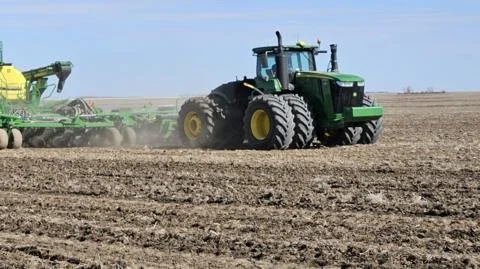
In the heart of Saskatchewan, Canada, Jake Leguee, a third-generation farmer, reflects on the transformative impact of technology in agriculture over the decades. Growing up witnessing the hard labor of his father and grandfather, Leguee highlights how modern-day innovations have drastically enhanced farming efficiency. His 17,000-acre farm employs state-of-the-art tools, such as software and remote cameras attached to his John Deere tractor, enabling precise weed control while simultaneously reducing pesticide usage.
Leguee’s experience mirrors a broader trend in North America, where a 2024 McKinsey survey revealed that 57% of farmers are eager to adopt new yield-increasing technologies. The decreasing number of farms juxtaposed with a rise in tech density underlines a significant shift in the agricultural landscape. Norah Lake, another farmer from Vermont, shares her insights on transforming traditional methods. Through a software called Tend, she has streamlined her data management processes, enabling precise calculations for planting and harvesting.
Companies like Syngenta are at the forefront of this agricultural tech revolution, offering products like Cropwise, which utilizes AI and satellite imagery to provide real-time updates and alerts on crop conditions. This technology empowers farmers to anticipate and mitigate problems, such as pest outbreaks or adverse weather conditions, ultimately ensuring a more robust food supply.
Furthermore, as explained by agronomist Heather Darby, this technological advancement not only supports farmers but could also lead to lower prices at the consumer level. A more controlled farming environment results in fewer crop failures, paving the way for a more reliable food system.
However, challenges remain with generational differences in adopting these technologies; younger farmers are more inclined to embrace them while some older farmers may resist change. Leguee emphasizes the necessity for farmers to view their operations as businesses and to adapt accordingly in an ever-evolving landscape. He aptly summarizes, “If you treat farming as a business, it’s a great way of life,” urging others to invest in innovations that enhance agricultural sustainability and profitability.